日本語
日本語
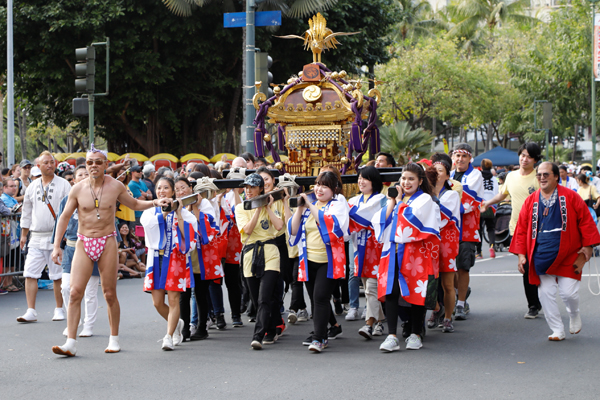
The Inaho Mikoshi (Rice Ear Portable Shrine) was crafted by Miyamoto Unosuke Shoten, a long-established mikoshi and taiko drum maker in Asakusa, Tokyo, founded in 1861 and renowned for more than 160 years of craftsmanship and tradition.
On April 28, 1994, the mikoshi was officially presented and sent from Japan to Hawaii following the “Inaho Mikoshi Hawaii Procession Commemorative Ceremony” held at Tokyo’s Ryogoku Kokugikan. The ceremony was attended by several distinguished Hawaii-connected sumo figures, including Oyakata Daigoro Azumazeki (former Takamiyama), Yokozuna Akebono, Ozeki Musashimaru, and Konishiki, who joined in the celebratory send-off.
After arriving in Hawaii, the mikoshi was first carried in procession at a festival hosted by the Japanese Cultural Center of Hawaii. The following year, in 1995, it was enshrined at Honolulu Hale during the opening ceremony of the inaugural Honolulu Festival. On that occasion, a ceremonial prayer for safety and success was offered by Chief Priest Haruo Hanawa of Kasama Inari Shrine, one of Japan’s three most celebrated Inari shrines.
Since 2001, the two Inaho Mikoshi—one large and one small—have become the property of the Honolulu Festival Foundation and are cherished as official symbols of the festival. Each year, they are displayed and carried during the Grand Parade, continuing to serve as a powerful symbol of cultural exchange and friendship between Japan and Hawaii.
Adult Mikoshi(Otona Mikoshi)
Height: 5 ft 11.7 in
Weight: 441 lbs
Children’s Mikoshi (Kodomo Mikoshi)
Height: 3 ft 11.2 in
Weight: 60 kg 132 lbs